Industry peers often ask: What are your goals, or what changes do you plan to make during your presidency? Answering that question is not easy, and the honest answer might be, none. That may sound short-minded or unambitious, but the reason and the entire answer are much deeper.
Those who have served on the board will probably agree: You can’t accomplish major changes in one year. It’s more important to serve on a board that has a common outlook so you can work as a team to implement changes over time. In fact, major changes in a single year could ultimately be harmful to an organization. I’ve been very lucky to serve on the board with a great group of leaders and dedicated members who have shared that common vision, which makes my year as president another year working on our common goal of becoming a more outward-facing organization whose goal is to help advance the industry.
Fire apparatus purchasing is a very different atmosphere today than it has been over the past 20 to 30 years. Purchasing committees tend to be much more educated today. That’s not to say that committees were uneducated in the past; there simply was not as much information available then as there is today.
Today, you can obtain detailed specifications on just about any product with a quick Internet search. If you don’t understand a system, you can watch online videos to become quickly educated to make better decisions. However, this abundance of information comes with a catch: At times, there is as much information as there is disinformation.
I’d like to borrow a term that one of my colleagues uses, which I think sums up things best: noise. It can be a challenge for committees to sort through the noise and focus on their priorities. A major source of that noise today is opinions. With the Internet, anyone can post an opinion, often with no backing of facts—simply to spark clicks and debate. There used to be a high level of professionalism in a news article—reporters would do research and only run with a story if they had a factual backing or at least had sources on record backing the reported facts. There are still many reputable news outlets, but with today’s technology, they are far outnumbered by the click- bait reporters, and it’s the responsibility of a good committee, chief, and leader to sort through this noise.
FAMA is a unique organization, best summed up in the organization’s mission statement: “FAMA advances the knowledge, safety, growth, and health of the emergency vehicle market.” Mission statements are designed to be short and impactful. I’d like to take a deeper look at the parts of the mission statement and explain what the organization does for each of those key points.
Knowledge is the first point in the mission statement, and it’s one that the organization has had a strong focus on in recent years. More than 50 apparatus manufacturers are members of FAMA—from small upfitters that build a few trucks a year to large OEMs that build all types of apparatus. What makes the organization unique from an education and knowledge standpoint is that by nature we are unbiased about products. If we were to slant an opinion to one brand or style of apparatus or component, the other members of FAMA would immediately call us out.
Over the years, FAMA has created dozens of “buyers guides,” which are documents that cover a specific topic on a component or apparatus type. These guides provide the end user with a general overview of the product, facts on what is available and possible, and ideas on specific details for specifications. The buyers guides are available as free resources to anyone at www.fama.org.
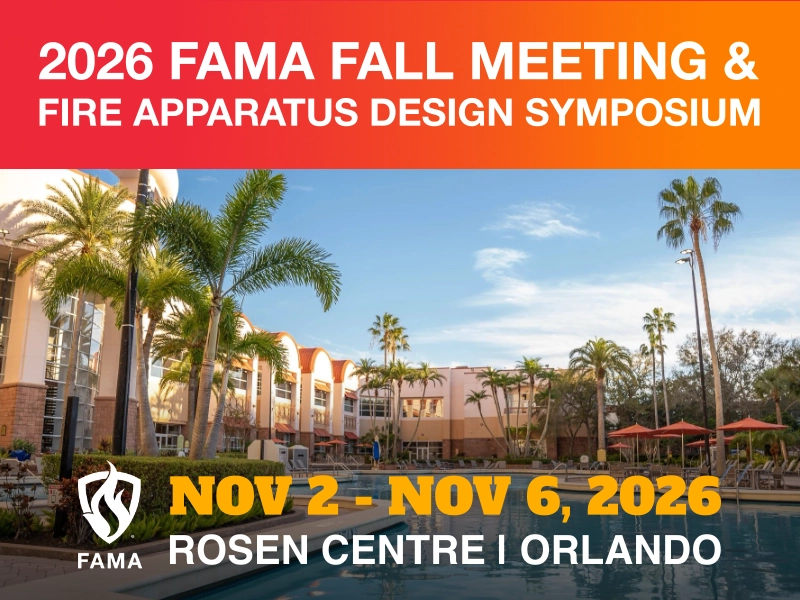
In 2025, FAMA launched the first annual Fire Apparatus Design Symposium. The inaugural event was an overwhelming success, and we are very excited about continuing this event in 2026. It will be held at the Rosen Centre in Orlando, Florida, November 3-5. Registration for the event is available through the FAMA Website. The apparatus symposium consists of several short classes designed to educate fire chiefs, purchasing managers, and apparatus committees on the various technologies available in the market. The approach is fully educational, with competing manufacturers presenting each topic. With this style of presentation, it prevents the sales pitch approach and, instead, focuses on facts and specifications.
Safety has always been a core focus for FAMA. The largest and most active committee in the organization is the technical committee. This committee works to advance the safety of emergency apparatus and create achievable standards. On the Website, end users can view the complete list of FAMA Control Symbols and Safety Signs. This committee created and maintains the apparatus safety guide, which is required per National Fire Protection Association (NFPA) 1900, Standard for Aircraft Rescue and Firefighting Vehicles, Automotive Fire Apparatus, Wildland Fire Apparatus, and Automotive Ambulances, to be included with every new apparatus delivery. FAMA is very active and holds a voting seat on several NFPA committees including, but not limited to, NFPA 1900.
There are always differing opinions on standards and codes. Some cynics believe standards are created simply to complicate vehicles and drive up the price. That’s a very short-sighted view. There’s no denying that some safety standards come at a cost, and if it’s determined that a feature is critical, the NFPA committee weighs the costs vs. the benefits and decides whether the standard should be adopted.
A great example of this is air bags in fire apparatus. This can be a highly controversial topic, and I’m not taking a stand for or against air bags here. I’m simply explaining the decision process. The cost for air bags in a fire apparatus is high. Unlike a passenger vehicle, the cost is broken out as an option, so many committees see the feature cost and must decide whether to adopt it or not. The NFPA has two sections:
- The base is a “shall” section, meaning that the OEM must include these items, and the apparatus purchasing committee basically doesn’t have a choice.
- The appendix is a “should” section, meaning it’s a suggestion but not a requirement.
Air bags fall into the appendix or “should” section, so they are not required by the standard. Each individual committee needs to weigh the cost vs. the benefit and make an educated decision on whether to include this technology.
The easy answer is to always include anything that improves safety, but it is not that simple. There are some people who believe that in a large vehicle like a fire truck, if the occupant is properly seated and belted, the air bag may not be necessary, as the cab is stronger than a typical passenger vehicle and less likely to have major intrusion into the occupant area in an accident. The addition of the air bags can often impact other equipment in the cab area and restrict some other options. Furthermore, the cost could require a committee to eliminate other options to stick to a specific budget. Then there is the ever-present argument that when things go wrong, you cannot put a price on the occupants’ life. As you can imagine, decisions like this are not easy to make.
The last section of the mission statement focuses on the health of the emergency vehicle market. This statement represents commitment to a symbiotic relationship. For emergency responders, “health” represents reliable access to accurate information, technology, expertise, and component parts. For FAMA members, “health” represents efficiency; access to highly skilled labor; and strong relationships with legislators, regulators, and end users. It also means supporting sustainable enterprises.
It’s well known that the fire apparatus industry is unique. Many of the components and parts are also unique—specifically custom-made parts for each brand of apparatus like cab doors, windshields, formed body parts, and many others. When an apparatus manufacturer goes out of business, many of those custom parts go away with the business, which makes maintaining apparatus more expensive and difficult. By understanding and promoting the various aspects of “health” across the emergency vehicle market, FAMA is committed to fostering strong and effective relationships that help fire responders save lives.
Our industry has battled through some difficult times, starting with the last great recession in the late 2000s, then the COVID outbreak that affected every business across North America, and now with things like constantly evolving tariffs. We embrace the challenges and will continue to not only support but advance this industry. I look forward to being a small part of that throughout 2026.
FAMA Forum creative content is contributed by unpaid volunteer authors. Any opinions expressed herein are exclusively those of the author and are not intended to represent the views of FAMA or its member companies.
https://www.fireapparatusmagazine.com/fama/fama-forum-supporting-and-advancing-the-industry/